Tet - The Beginning
Correspondence I · Instructional Writing
Published September 2026
I want to begin this correspondence with an introduction to who I am and what I believe. I hope that something in my story and my dream resonates with you. I also hope that this will set the tone for the work to come and allow you to determine for yourself whether this is something in which you would like to become involved.
Of course, I would love for everyone to be involved—but that is not my choice to make.
I am a millennial born in Hartford, Connecticut—my hometown. Growing up, I did not fully appreciate its rich history and culture as much as I now wish I had. In fact, it took many years for me to return to Connecticut after actively avoiding it.
Connecticut is rich in history. Look around; there is no escaping it. At the same time, it is culturally rich—a meeting place of people, traditions, interests, and values.
In many ways, some of the earliest experiments that eventually shaped our country took place here. I believe that it is also here that we may find some of the medicine needed for our troubled time.
This place can be a place for all people.
And you and I can work together to help make it so.
What Does This Have to Do with Magick?
You might wonder.
Thank you for asking!
Magick, like anything else we do, does not happen in a vacuum. We are small parts of a much larger matrix—a connected web. Anything and everything we do ripples outward and affects the world around us.
I am a firm believer in this principle. If you have spent time working within metaphysical traditions, perhaps you have encountered something of it yourself.
Therefore, effective magicians must also strive to be connected magicians, aware magicians, and active magicians.
We must understand the context in which we live—the story of ourselves—before embarking upon what has often been called the Great Work.
I will explain what I mean by the Great Work. But first, let me summarize this first principle:
Magick and community go hand in hand.
To practice effectively, we must understand the context in which we live.
This means more than geographical context—where we live. It includes temporal context—where we are in time; historical context—where we stand in relation to what has been; cultural context—who we are in relation to others; spiritual context—the unseen dynamics through which we interpret and experience our world; and personal context—who we are, who we have been, and who we are becoming through our values, beliefs, and habits.
The Great Work
So what is the Great Work?
Religions, philosophies, and spiritual traditions have attempted to answer this question through lore, revelation, philosophical reasoning, historical experience, and, at times, arbitrary speculation.
Yet beneath all of these efforts lies a deeply personal question.
What is the purpose of your life?
What is your potential?
How do you fit into all of this?
I believe that you already possess something of this knowledge within yourself. No one else can completely supply these answers for you. Others may teach you, challenge you, inspire you, or walk beside you—but ultimately, you must encounter these questions yourself.
You have more within you than you may realize.
At first, this may seem contradictory to the point I made earlier.
But herein lies one of the keys to the Great Work.
You and I are reflections of the cosmos, possessing creative potential of our own. At the same time, the cosmos and the world around us continually shape us.
There are great and mighty forces external to us, just as there are magnificent instruments of creation and manifestation already within our reach—no purchase necessary!
How do these realities come together?
That is the Great Work.
Unity.
Harmony.
I recently encountered a passage from Gregory Cajete's Native Science: Natural Laws of Interdependence that expresses something close to what I mean:
“An immature cosmology spawns immature individual values and institutions. But the immature Faustian individual is experiencing final self-indulgence. The era of the ‘ecological individual’ is by necessity dawning. As our society’s cosmology has misfired, resulting in environmental destruction, so have its philosophies, values, actions, and guiding institutions. The creation of an ecological cosmology with its philosophy for the individual must now be sought...”
— Gregory Cajete, Native Science: Natural Laws of Interdependence
There are two terms in this passage that I would like to explore: Faustian and cosmology.
My hope is that, by considering these terms alongside everything written above, you will begin to recognize the nature of the work before us.
Faust
Faust is the central figure of a German legend that has taken many forms: the man who makes a bargain with the Devil in pursuit of knowledge, experience, power, or worldly fulfillment.
From the perspective of the modern witch, warlock, pagan, occultist, magician—or anyone who deeply values individual freedom—the story can initially appear to be a warning against unrestricted choice.
After all, what we choose is our choice. No one should determine our lifestyle or unnecessarily restrict our freedom.
This is freedom.
But I think there is something deeper in the story.
Faust had free will.
He exercised it.
And that, in itself, is not the problem.
Every choice, however, involves an exchange. To choose one thing is often to relinquish another.
So what did Faust gain?
He gained knowledge, power, experience, and access to material pleasures—the bright and glittering things of this plane of existence.
In my reading of the legend, Faust represents a consciousness increasingly directed toward acquisition, control, knowledge, and power at the expense of relationship.
His attention becomes focused upon what can be possessed, measured, manipulated, or brought under the authority of the individual.
I am no literary scholar and do not claim to be. This is simply the interpretation I receive from the legend.
So what did Faust sacrifice?
Connection.
Harmony.
He became dissonant with everything but himself.
His world became bounded by his own appetites and ambitions. Rather than allowing his senses to reveal a deeper relationship between himself and the world around him, the world increasingly became something to acquire, command, or consume.
That was his choice—good, bad, or neutral.
I choose to see this as a rejection not of religion, but of connection.
There are many versions of the Faust legend, and they differ considerably. But the theme I take from them is simple:
We often sacrifice connection for our own gain.
And sometimes, knowingly or unknowingly, we discover that what initially appeared to be freedom has created another kind of bondage.
We exchange the possibility of a spiritually free life for a life of endless striving, possession, anxiety, and fear.
I want to be clear: I am not offering an answer.
I am identifying a pattern.
My hope is that this pattern resonates enough to clarify what I hope this community of magicians might become—and what I hope our relationship with one another might offer.
Cosmology
Now, somewhat abruptly, I wish to turn to the second term: cosmology.
Cosmology is, in one sense, our origin story. It asks how the universe came to be, how it is ordered, and what conditions make possible the birth and continuation of the natural world as we know it.
Religion offers answers.
Science offers answers.
Philosophy offers answers.
Yet there is another, quieter storyteller: our philosophies, values, actions, and guiding institutions.
A cosmology is more than a story about how the universe began. It is also a story about what kind of world we believe ourselves to inhabit and how we understand our place within it.
If we value individuality above connection, technological advancement above ecological awareness, profit above responsibility, and ego above community, then we are continually retelling our cosmology through the society we create.
Our beliefs are made visible through our institutions.
Our values are made visible through our choices.
Our understanding of the world is made visible through the way we treat it.
A society organized entirely around domination and competition implicitly tells us that the individual human being stands apart from the rest of existence.
It tells us that nature is principally a resource.
It tells us that strength means overpowering what is weaker.
It tells us that survival belongs to whoever can take the most and hold it the longest.
But this is only one way of interpreting the natural world.
Nature also reveals interdependence, cooperation, adaptation, reciprocity, mutualism, and relationship.1
We cannot survive independently of everything else.
The air, soil, water, microorganisms, plants, animals, landscapes, and communities around us are not incidental scenery surrounding human existence.
They are conditions of human existence.
Ignore our connections long enough, and eventually we discover that we cannot exist without them.
So, in summary:
It is time to cultivate a cosmology that supports ecological harmony.
I hope that you share something of this view with me.
This marks the end of my exposition on my own beliefs.
The Society of New London
Now, regarding the Society of New London, to which I devote this work:
I seek people of all creeds, belief systems, traditions, and magickal currents who can unite around one purpose above all others:
The well-being of the New London community.
How we pursue this goal—including through magickal means—is secondary to the goal itself.
I hope that everything written above makes clear that this is not intended to be a coven, a religious organization, or a secret society.
Although some of the energies, practices, and techniques with which we work may traditionally be approached privately or away from public view, our relationship with the community itself should remain visible.
If I had to compare the Society to an existing institutional structure, I would describe it as something between a lodge and a community nonprofit—but without rigid dogma or the insistence that there must be some exalted leader standing above everyone else.
Everyone has a seat at the table, provided that we sit at that table united in purpose and vision.
I hope that this explains who I am and the purpose of this group in sufficient detail.
Until we meet,
— The Organizer
Actions
Each correspondence will offer an opportunity to connect in some way.
This may take the form of a question to consider, an investigation to undertake, a meditation to perform, or another kind of practice.
These are invitations, not obligations.
You are never required to perform or participate in an activity that you do not wish to undertake.
Whatever you do in relation to this collection of people, may it arise from your own desire, judgment, and need.
Dialogue
Within the coming weeks, if you feel inclined, I invite you to reflect upon these questions and respond in whatever way feels appropriate.
Does this vision resonate with you?
What values are important to you?
What progress would you like to see in New London?
What corners of the city tug at your curiosity?
Are there places where you find solace?
Perhaps there are local spirits, histories, landscapes, or energies toward which you feel particularly drawn.
Share whatever you wish.
And may you live and dwell in abundance.
Ritual
Preface
Symbols form languages—some easier to read than others.
There is also a dimension of symbolic language that is more difficult to express: the effect that a symbol may have upon our attention, imagination, and awareness.
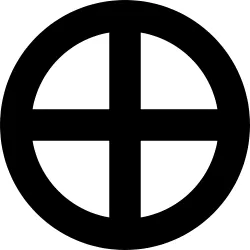
For this correspondence, I have chosen the image of the cross within the circle, commonly called the wheel cross or solar cross.
The wheel cross. In this correspondence, I place this form in symbolic relationship with Ṭet and Sowilo. These are correspondences within this work, rather than claims that the symbols are historically or linguistically identical.
An early form of the Phoenician letter Ṭēt bears a resemblance to an enclosed or crossed form, and the Hebrew letter ט — Tet ultimately descends from that Phoenician letter.
I also place the symbol in correspondence with Sowilo, the Germanic rune associated with the sun.
These symbols are not historical equivalents.
Rather, I am bringing them into relationship through correspondence.
Within my own practice, I associate this image with themes of potential, enclosure, emergence, light, rebirth, and creative generation.
I also associate it with the generative and divine feminine—the womb as an image of potential through which something concealed may eventually enter the world.
For this reason, I find it an appropriate symbol with which to mark the commencement of our connection, should you wish to sustain it.
The Practice
First, spend some time contemplating the symbol.
Hold in your awareness the themes of:
Connection.
Rebirth.
Light.
Creative divine energy.
Do not feel obligated to force an interpretation or experience. Simply spend some time with the image and observe what arises.
Allow some time to pass—perhaps at least a day.
Then return to the symbol.
On this second occasion, contemplate community.
What does community look like when empowered by compassion?
What does it look like when animated by light and love?
What would a spiritually connected New London look like?
What would it mean for its people, its land, its waters, its animals, its buildings, and its histories to exist in greater harmony?
Return to this meditation as often as you find useful, holding the intention of connection with others who share the same purpose.2
Readings & Investigations
The law of correspondences is fundamental to many forms of magickal practice.
Whether you are a veteran practitioner or are only beginning, I invite you to ask:
Is there something more I can learn about correspondence?
If this concept is unfamiliar to you, spend some time reading about it.
If you are experienced, challenge yourself further.
Can you draw correspondences between object, archetype, place, history, and energy with ease?
If so, find something within our community that interests you.
It may be tangible, immaterial, natural, architectural, historical, or abstract.
Study it.
What energies do you associate with it?
Then place those correspondences within their local context.
What might the presence of this object mean within the place in which it exists?
Suppose, for example, that you encounter a yarrow plant growing from the side of an old building.
Yarrow has accumulated associations with healing and protection in a variety of folk traditions.
So you might ask:
Does the building itself possess some historical relationship with healing?
Do other healing-related plants, institutions, stories, or symbols appear nearby?
Is this merely coincidence?
Is it meaningful to you?
Does a pattern emerge only after sustained observation?
And, most importantly:
How might whatever you discover be harnessed for the greater good of our community?
That is the investigation.
I should mention that I studied physics and retain a deep love of science. I do not see scientific reasoning and an ecological worldview as enemies. Evolution, for example, describes competition but also accommodates cooperation, mutualism, adaptation, and interdependence. My concern is not with evolutionary theory itself, but with the cultural habit of reducing nature to competition alone. The philosophical lens through which we interpret scientific knowledge matters.↩
Please meditate only in whatever capacity you are comfortable with. If cleansing, protective practices, or spiritual preparation are already part of your tradition, you may choose to incorporate them. If these ideas are unfamiliar to you, there is no need to undertake practices that make you uncomfortable. Resources from a variety of traditions may be shared separately for those who wish to learn more.↩